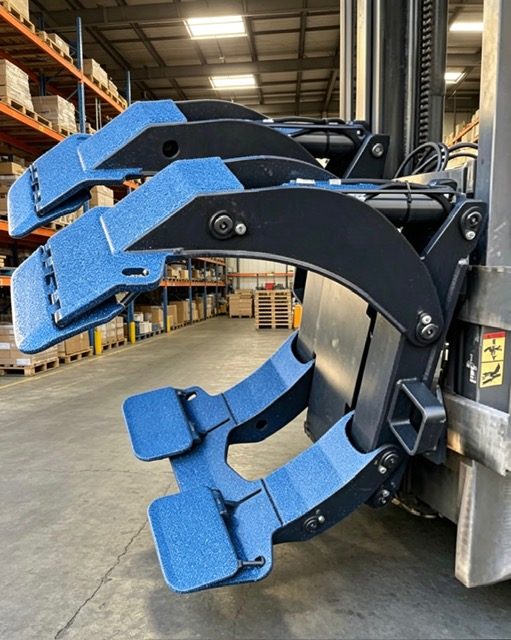
Stopping Load Slip on Forklift Tines, Loader Arms, Rollers & Process Equipment
Slipping and falling underfoot isn't the only traction problem on an industrial site — materials handling operations lose time, stock and occasionally safety incidents to loads slipping on forklift tines, loader arms and lifting attachments, particularly when handling paper, cardboard or timber.
Why loads slip on lifting equipment
Standard steel tines and loader arms are smooth by design — good for sliding a load on and off, but offering little friction to keep it in place during lifting, tilting or transport. Paper reels, stacked cardboard and timber loads are particularly prone to shifting because of their surface texture and weight distribution.
The cost of load slip
Beyond the immediate safety risk of a shifting or dropped load, repeated load slip causes product damage, rework, and slower, more cautious handling — all of which add up in a high-throughput operation.
Adding positive grip without changing your equipment
Rather than replacing tines or loader arms, a bonded traction surface can be applied directly to the existing attachment, adding grip exactly where the load contacts the equipment. This is the approach behind Corrotec's Helion GripTech — a positive-grip surface fitted to forklift tines, loader arms and lifting attachments, manufactured to match your specific equipment rather than a generic size.
Explore [Helion GripTech — traction plates for forklifts and loader arms, rollers & process equipment]