Access Ramp Requirements — Approved Document M and Anti-Slip Considerations
Providing safe, accessible routes into and around a building isn't just good practice — it's a legal expectation under the Equality Act 2010, and Approved Document M sets out the practical guidance most specifiers work to when designing ramps and level-access routes.
What Approved Document M covers
Approved Document M addresses access to and use of buildings, including guidance on ramp gradients, landing sizes, handrail provision and surface characteristics for accessible routes. Slip resistance is a recurring theme throughout — a compliant gradient is of limited value if the surface itself doesn't provide adequate grip in wet or contaminated conditions.
Why slip resistance and access compliance go together
An access ramp is often used by people for whom a slip carries a higher consequence — wheelchair users, those with mobility aids, and anyone less able to recover from a stumble. This makes surface grip a genuine safety issue, not just a compliance checkbox.
Specifying anti-slip access ramps
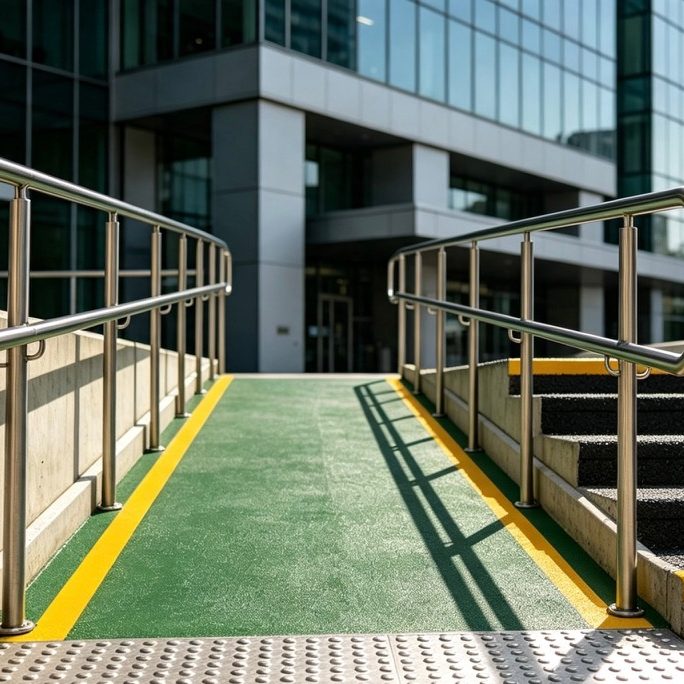
When specifying a ramp or access plate, look for a gritted, bonded aggregate surface rather than a smooth or painted finish, gradient calculations that reflect the actual site levels (not a generic assumption), and clear edge definition to help users identify the ramp boundary.
Corrotec's Helion Access range is designed with these access and grip principles in mind, manufactured to your site's exact ramp dimensions in steel or aluminium. For any project with specific compliance sign-off requirements, we'd always recommend confirming the full specification with your building control or access consultant alongside our product spec.